

My hands were not built for cutting onions three nights a week. I have mild arthritis in my right wrist, diagnosed about two years ago, and by the time I finish prepping garlic, half an onion, and a bell pepper, that joint aches for the rest of the evening. I tried soaking my hands beforehand. I tried lighter knives. Nothing really helped until I picked up the Hamilton Beach Electric Vegetable Chopper, the little 3-cup, 350-watt one that costs less than a decent lunch out. That was four months ago, and I want to tell you exactly what using it week after week is actually like, not just what the box promises.
I cook for my mom, Leilani, who is 81, and her neighbor Dorothy, 76, three evenings a week. They live in the same building in a two-bedroom apartment with a galley kitchen about the size of a hallway. Counter space is precious. I am also trying to leave enough morning time for nine holes of golf, which means I do most of my meal prep the evening before or in quick bursts. A tool that saves me ten minutes of knife work and protects my wrist is not a luxury for me. It is how I stay sane.
The Quick Verdict
A genuinely useful mini chopper for small households. Reliable, easy to clean, and gentle enough for tired hands. A few limits on harder vegetables, but nothing that stops you from cooking well.
Amazon Check Today's Price →Your wrist deserves a break. Here is the chopper that gives it one.
The Hamilton Beach 3-Cup electric food chopper handles onions, garlic, herbs, and soft vegetables in seconds. Rated 4.6 stars across more than 36,000 reviews. At the current price, it is one of the lowest-risk kitchen tools you can add to a small space.
Amazon Check Today's Price on Amazon →How I Have Used It Over Four Months
I use this chopper roughly three times a week. My typical jobs for it are: half a yellow onion for a stir-fry, two or three garlic cloves for a marinade, fresh ginger for soup, a handful of cilantro or parsley, and occasionally a soft bell pepper. Once or twice I tried it on a raw carrot and a small piece of butternut squash. I will get to those in a moment.
The routine is simple. I drop in the ingredient, snap the lid closed, and press down to pulse. The lid press is the on switch. There is no separate power button, no dial, no digital panel. You press, it chops. You lift your hand, it stops. For someone who does not want to think too hard at the end of a caregiving day, that matters. The whole unit is about the size of a large coffee mug, so it lives on the counter permanently without crowding anything else out.
In four months I have run it probably 50 to 60 times. The motor still sounds exactly the same as day one. No burning smell, no wobble, no weird vibration. That consistency surprised me a little, honestly. At this price point I expected some signs of wear by now.
What the 350-Watt Motor Actually Does Well
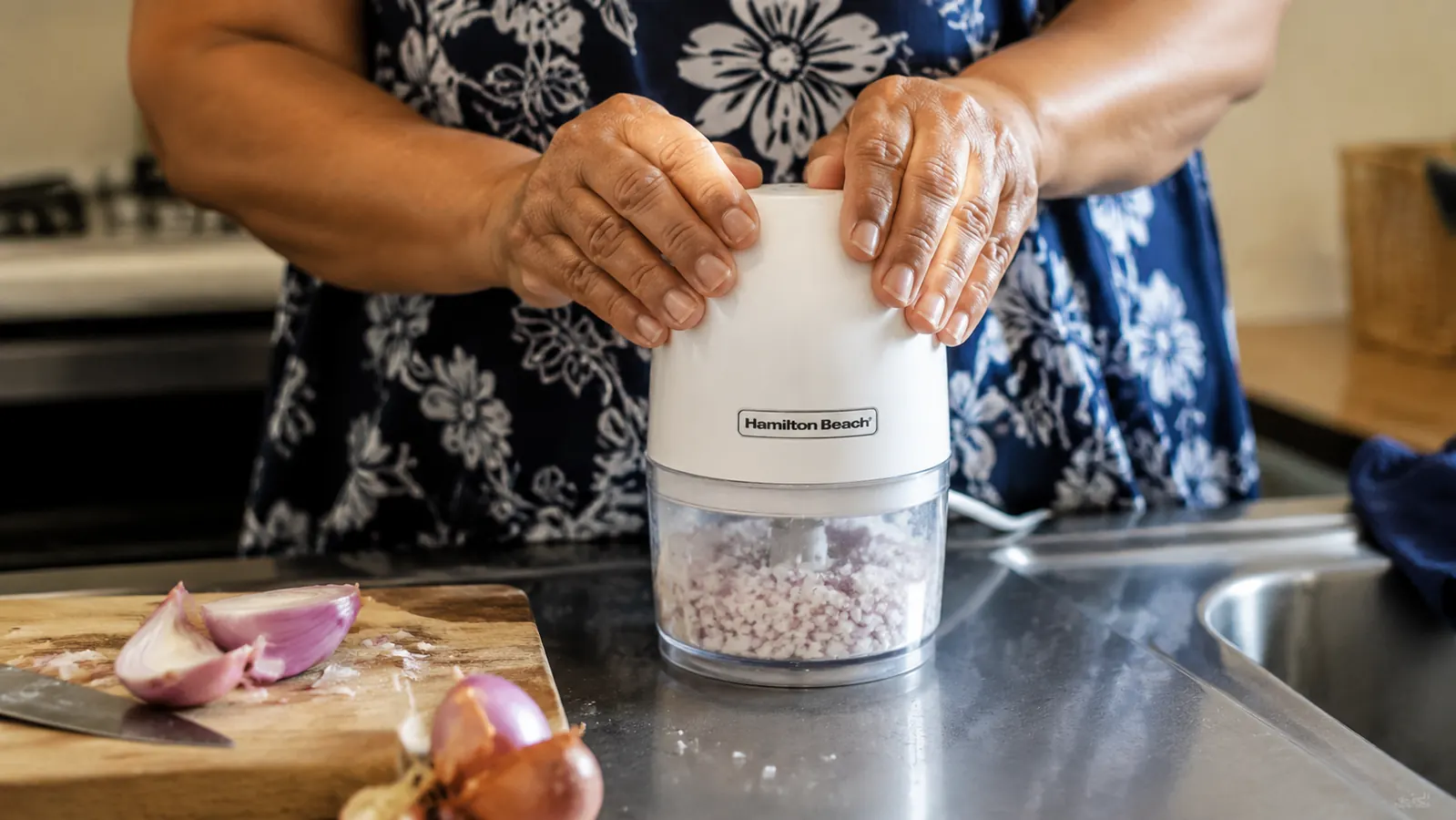
Onions are where this chopper earns its place on my counter. Half a medium yellow onion goes from whole to evenly diced in about five to eight pulses. No tears, because my face is not anywhere near the cutting board while it runs. No uneven chunks. The result is what I would call a competent home-kitchen dice, not a restaurant-perfect brunoise, but fine for every dish I make.
Garlic is even easier. Two or three cloves go in, four pulses, and I have minced garlic without the sticky fingers or the smell baked into a wooden cutting board. Fresh herbs chop cleanly too. Cilantro in particular, which can clump and smear under a knife, comes out evenly cut in three or four pulses. I do four pulses, check, do two more if needed. The pulse-only design means I am in control of how fine the cut gets.
Fresh ginger is one I did not expect to work this well. I peel a small knob and drop it in with a few garlic cloves for my mom's favorite ginger-soy chicken. Two or three pulses gives me a rough mince that melts into the sauce. Before this chopper, I was grating ginger on a microplane, which is manageable but slow and leaves cleanup on the grater prongs that takes real scrubbing. This saves me that step entirely.
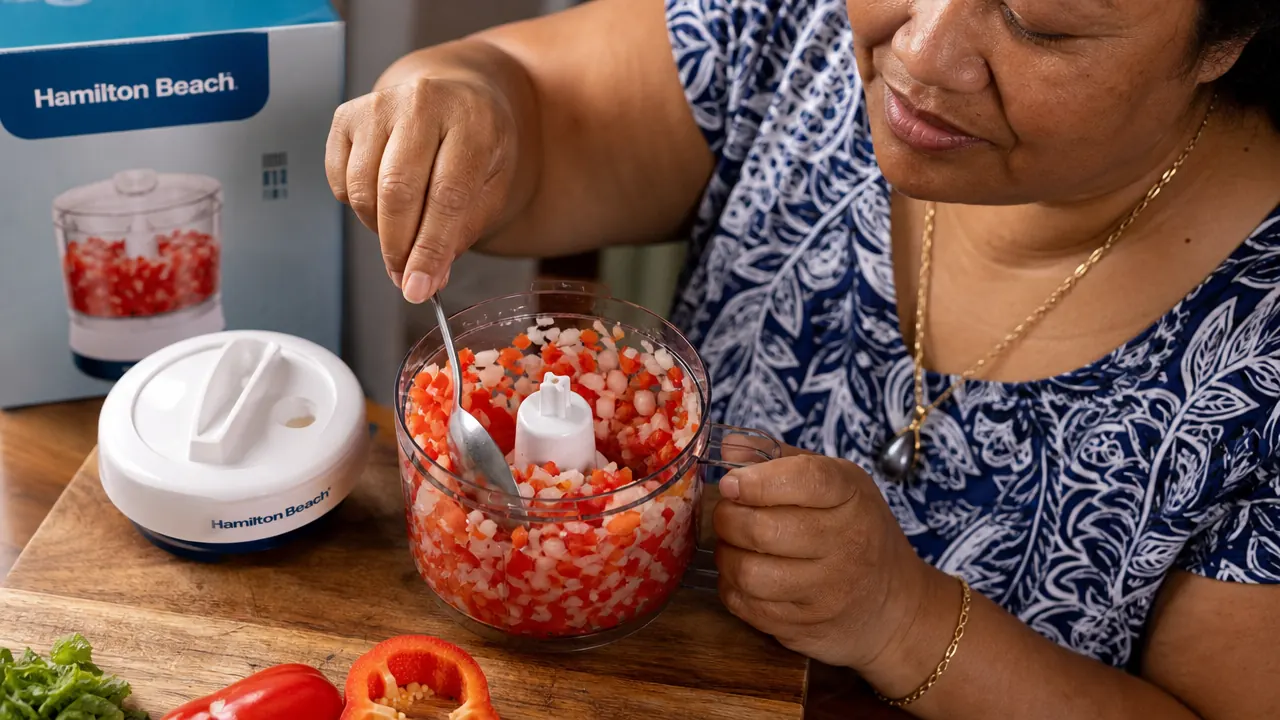
Soft cooked vegetables, like steamed sweet potato or canned chickpeas that I want to rough-chop for a simple salad, also work without any complaint from the machine. The 3-cup capacity is genuinely useful for cooking for two. I do not have to do multiple batches for a normal weeknight prep. One pass and I am done.
Half an onion, evenly diced, in about eight pulses. No tears, no aching wrist, and cleanup takes ninety seconds. That is the whole pitch, and it holds up four months later.
Where It Has Limits (And I Am Being Honest About This)
Raw carrots challenged it. I cut a medium carrot into rough chunks and tried to chop them. The motor handled it, but the result was uneven. Some pieces came out too large, some too small. I had to pulse a lot more than I expected and still ended up picking out a couple of larger chunks to chop by hand. If you need finely diced raw carrot for a salad or a stew base, plan for it to take more effort than softer vegetables.
Hard squash was a similar story. I cut butternut squash into small cubes first, and it managed, but it was working hard. The sound changed pitch slightly. I would not push it with anything harder than a raw zucchini going forward. This is a mini food chopper rated at 350 watts, not a full-size food processor. It is honest about what it is, and as long as you match your expectations to that, you will not be disappointed.
The 3-cup bowl also means you cannot do a large batch. I prep for two people, so it never bothers me. But if you cook for four or five people and want to chop two full onions at once, you will need to do two passes. For a small household, it is a non-issue.
Cleanup: The Detail That Won Me Over
I did not expect cleanup to be one of the best parts. It is. The bowl, lid, and blade all come apart and go straight into the top rack of the dishwasher. When I wash by hand, which I usually do because Leilani's apartment has a small dishwasher that fills up fast, it takes about ninety seconds. The bowl is smooth plastic with no hard-to-reach seams. The blade is sharp enough to do its job but not so sharp that rinsing it is dangerous. I rinse, give it a quick wipe, and set it in the drying rack.
Compared to cleaning a large food processor, the difference is enormous. I owned a full-size Cuisinart for years and eventually stopped using it partly because breaking it down, washing all five pieces, and putting it back together felt like more work than just chopping by hand. This one removes that friction entirely. The fact that it only has three pieces is not just convenient, it is the reason I actually reach for it every week instead of leaving it in a cabinet.

Ease of Use for Tired or Arthritic Hands
The lid press-to-run design is genuinely good for my wrist. I am not twisting a dial, pressing a small button, or fighting a lever. I place my palm flat on the lid and press straight down. That motion uses my whole forearm rather than isolating my wrist joint. On a bad arthritis day, I can still use this comfortably.
The unit is light enough to move with one hand. I often carry it from the counter to the sink without thinking about it, and it does not feel like a burden. The base does not have the most aggressive suction cup feet I have ever seen, but it stays put on a dry counter. On a wet counter it slides a little, so I keep a small silicone mat under it as a habit.
There is no auto shut-off in the traditional sense, since the motor only runs while you hold the lid down. The moment you release pressure, it stops. That is actually a safety feature in itself. The machine cannot run unattended or continue running if you step away. For caregiving situations where someone else might pick up a kitchen tool without knowing exactly how it works, that simple design removes a lot of worry.
How It Compares to What I Used Before
Before this I was splitting the chopping between a knife and a handheld manual chopper, the kind you press down on a spring-loaded blade. The manual chopper was fast for soft vegetables but put a lot of compression force on my palm, which my wrist did not love. It also leaked juice through the bottom if I used a ripe tomato. I stopped using it after about three months.
The Hamilton Beach removes both of those problems. The motor does the work. No compression force on my hand beyond the light palm press on the lid. And the sealed bowl keeps juice and moisture contained until I choose to open it. For a direct comparison between this and the Cuisinart Mini-Prep, I wrote a separate piece you can read here: Hamilton Beach Food Chopper vs Cuisinart Mini Prep. The short version is that the Hamilton Beach costs less and is easier to clean, and the Cuisinart has a slightly more powerful motor. Depending on what you chop most often, either could be the right call.
What I Liked
- Lid-press operation is gentle on arthritic or tired wrists
- Three parts only, all dishwasher-safe and fast to hand-wash
- Compact footprint, stays on the counter without crowding a small kitchen
- Consistent motor performance after four months of regular use
- Excellent for onions, garlic, fresh herbs, ginger, and soft vegetables
- Press-to-run design means it stops the instant you lift your hand
Where It Falls Short
- Struggles to chop hard raw vegetables like carrots or dense squash evenly
- 3-cup capacity means two passes for larger batches
- Base can slide slightly on a wet counter without a mat underneath
- No separate speed settings, only one pulse mode

Who This Is For
This chopper is a good fit if you cook for one or two people most nights, deal with any hand or wrist fatigue that makes knife work uncomfortable, and want a tool that cleans up in under two minutes. It is especially useful if your kitchen is small and every inch of counter space counts. At its current price, you are not being asked to take a big financial risk to find out if it works for you. If you mostly prep onions, garlic, herbs, and soft vegetables, it will handle your needs reliably and without fuss.
If you want to explore more reasons this style of tool fits a small kitchen routine, I put together a list: 10 Reasons a Mini Food Processor Makes Cooking for One So Much Easier. Worth a read if you are still deciding whether this kind of appliance earns its counter space.
Who Should Skip It
If you routinely batch-prep vegetables for four or more people, you will find the 3-cup bowl too small and you will spend more time doing multiple passes than you would just using a knife. If you regularly need finely chopped hard vegetables like raw carrot, turnip, or raw beet, a more powerful full-size food processor would serve you better. And if you want multiple speed settings or a pulse-and-hold option, this simple press-lid design will feel limiting. It is not a machine that tries to do everything. It does the basics extremely well, and for a certain kind of cook that is exactly enough.
Four months in, I still think this is one of the better low-cost kitchen tools I have bought. Not because it is fancy, but because it fits the way I actually cook. It is on my counter every week. I have not gone back to the manual chopper. My wrist is grateful, and honestly, so is my golf game, because I am not showing up to the first tee with a sore hand from the night before.
Four months in, I still reach for this first. Here is where to check the current price.
The Hamilton Beach 3-Cup Electric Food Chopper is rated 4.6 stars by more than 36,000 people. It is light, fast to clean, and genuinely easy on tired hands. If you cook for one or two and want to spend less time at the cutting board, this is worth looking at right now.
Amazon Check Today's Price on Amazon →